'Not just a single judicial event': South Korea's constitutional climate ruling 20 months on

It has been nearly two years since South Korea’s Constitutional Court made a landmark ruling, ordering the state to back its headline climate goal with more concrete targets over the next two and a half decades.
The decision consolidated four distinct climate cases. Three of these argued that national goals to curb emissions fall far short of what is required: the first was filed by 19 young people; the second was fronted by 62 children including what was then a 20-week-old foetus; the third was by 123 members of civil society organisations, leaders of political parties and ordinary citizens affected by climate change. The fourth case was brought by 51 Korean nationals who took particular aim at the country's first carbon neutrality plan.
The hundreds of campaigners fronting these lawsuits, as well as those working behind the scenes, had waited eagerly for a final decision. But few more so than the young activists at the heart of the first case, who had filed it back in 2020 through a local branch of the youth climate movement Youth 4 Climate Action.
One of those people was Kim Borim, who, while not a plaintiff, was in charge of strategising and designing the campaign. “There was really no way to predict the outcome of the decision,” Kim tells The Wave, speaking through an interpreter, “because this was not only the first case against the country's government on the climate crisis, but also it was the first case of its kind in all of Asia.
"We had conviction that these are rights that we have to fight for and that we do deserve"
“A lot of people doubted the eligibility or the appropriateness of the youth being plaintiffs in this," she says. "However, we had conviction that these are rights that we have to fight for and that we do deserve. So that is what carried us through.”
The judgment in August 2024 was not a total victory because the court did not require the country to set up a more ambitious 2030 target as it had been asked.
But it did say that the law as it stood did not conform with the constitution. The country, it said, must establish legally binding targets to cut emissions for the period 2031-2049. These targets must be based on a legal framework that ensures a continuous reduction of greenhouse gases, must take into account South Korea's share of global efforts based on science and international standards, and should not put an unfair burden on the future.
The National Assembly - South Korea’s legislative body - was ordered to amend the Carbon Neutrality Act to do this by 28 February 2026.
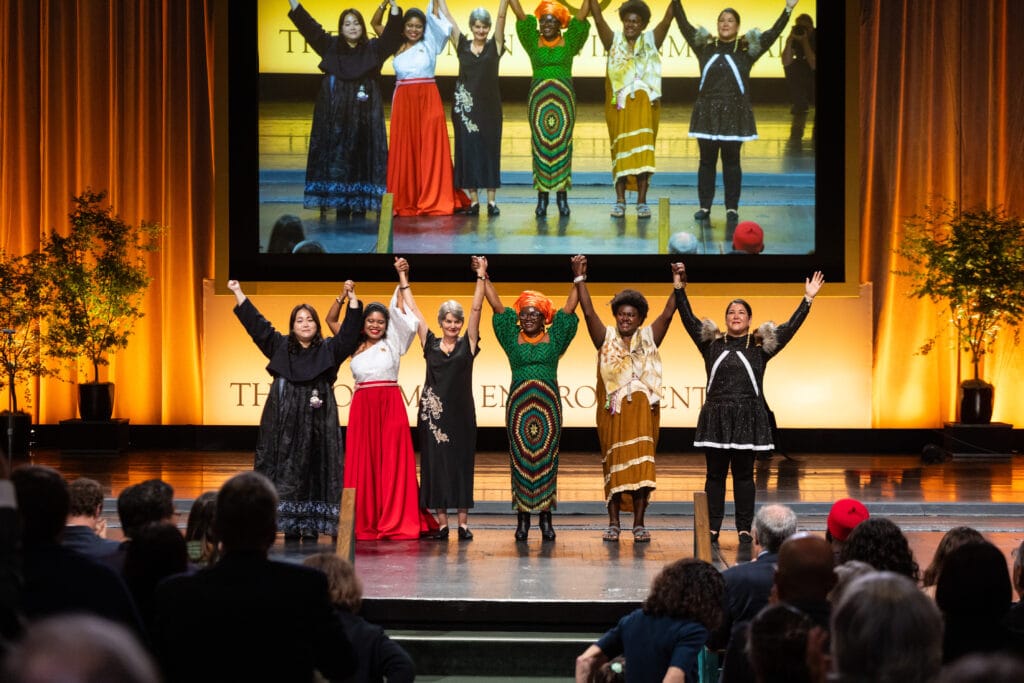
The Wave speaks to Kim as she is about to receive this year's Goldman Environmental Prize, a prestigious award for grassroots environmental activists. She is not the only one involved in climate litigation to win this year; UK activist Sarah Finch, whose legal success The Wave recently reflected on, is another recipient.
Kim describes being overwhelmed hearing the court’s final judgment in 2024, but says she also found it difficult to imagine at the time how it was going to result in real change.
Then, shortly afterwards, tens of thousands of people came out to protest in Seoul, demanding more concerted action on climate change.
“I think what was more important than the decision itself at the court was the time that we put into figuring out what that decision actually meant,” says Kim. “The more we looked into it, we realised that it was a recognition of citizens’ environmental rights and that the responsibility to respond to the climate crisis should not be delegated to future generations. So it came as a centering point for our activism.”
Political delays
But soon after the country was thrown into political chaos, with then president Yoon Suk Yeol unexpectedly declaring martial law in December 2024 and then being impeached and most recently imprisoned for life. “This resulted in a huge waste of time regarding the implementation of the Constitutional Court decision,” says Youn Sejong, director of non-profit Plan 1.5 who represented the young people in their claim.
Ideally, the National Assembly would have figured out its new climate targets in time to include them in its latest nationally determined contribution (NDC) to the Paris Agreement before COP30 in November 2025. But with a whole new government being elected in June 2025, this became impossible.
The updated NDC did include a tougher target, committing the state to cutting greenhouse gas emissions by 53-61% by 2035 compared with 2018 levels. Although experts still don’t think it is strong enough to align with the 1.5°c warming threshold, it was likely strengthened by the Constitutional Court’s judgment.
Youn notes that the ruling was referenced during NDC discussions and the top of the range (61%) aligns with the Intergovernmental Panel on Climate Change’s (IPCC) 1.5°c global pathway for the first time. And while the lower part of the range (53%) essentially represents the status quo, it was stronger than the 48% pushed for by industry and some government ministries. “Without the Constitutional Court decision, there would have been a very good chance that the NDC would have been even weaker,” he says.
With the February 2026 deadline missed, the National Assembly is now finally working on an amendment to the Carbon Neutrality Act that will enshrine new targets, which it expects to complete by the end of May.
To support this, it began a ‘deliberative polling’ process in February, a modified form of citizens’ assembly, a group of ordinary people discussing a particular topic that has been proffered as an effective way of supporting tough decisions such as those on climate.
Kim was involved in helping to design the discussions and as an observer. The panel was made up of around 300 randomly chosen citizens, who underwent several weeks of discussions and four televised debate sessions. It recently concluded that South Korea's greenhouse gas reduction target should at the very least fall into line with the IPPC’s 1.5°c pathway (see document below).
Not just that, but national policies should shift the burden of that reduction earlier rather than later. This was not a given; there was anger that the option of delaying carbon reductions was even an option for participants to vote on. But in the end the vast majority seemed to agree with the findings of the National Human Rights Commission and other bodies; earlier action makes good economic sense and does not shift the burden unfairly to future generations.
The results were shared on 13 April at a meeting of the Special Committee on Climate Crisis, which has said that it will take note of the results.
Kim says she was surprised at how positive the outcome of the deliberation process was. “I have seen in other countries where, even after winning a case, it was hard to see progress afterwards. And I thought it would be similar in Korea.
“However, in the citizens’ discussions they wanted to take more responsibility, and voiced that we need local transformation in order to respond to the climate crisis. I was very happy to see that this decision is actually leading to this kind of social change.”
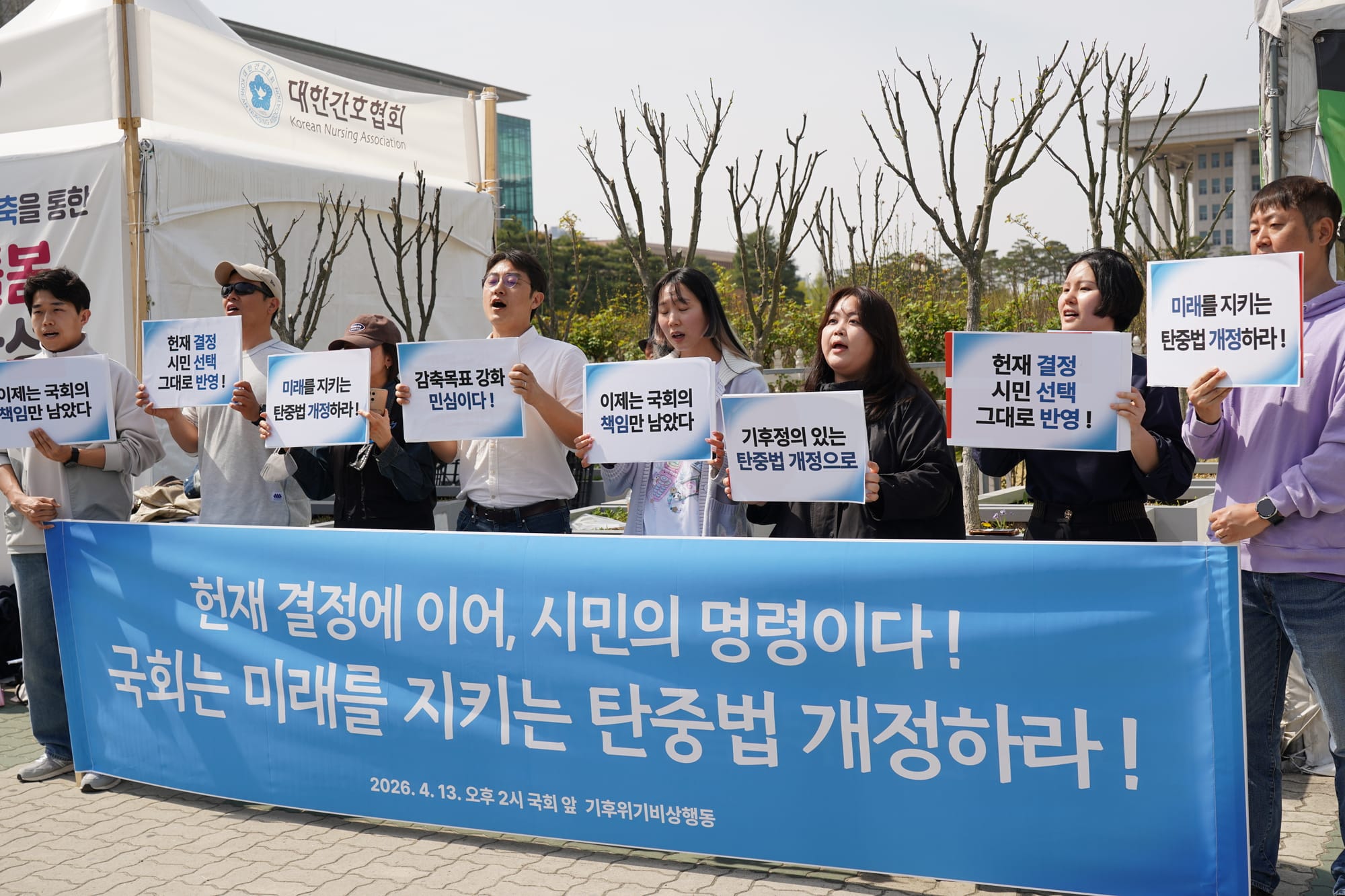
Youn notes that the result of the deliberation is not binding. “However, because it is a strong affirmation of the ruling of the Constitutional Court, I believe it carries significant weight and it will be quite burdensome for the lawmakers to go against it. Afterall, it is the constitution that has spoken on the matter.” He believes it is “logically inevitable” that the 2035 target range should now be amended, although again it is ultimately up to parliament whether to do so.
There has already been push-back from some conservative politicians that enhancing climate targets now would be too burdensome. And the ongoing energy crisis could complicate things; Korea is delaying the planned shutdown of several coal-fired power plants although current president Lee Jae Myung also seems to be trying to frame renewables as a security solution as well as a climate one.
“The Constitutional Court was not necessarily just a single judicial event,” Kim reflects. “It was more of a social movement, and we've been campaigning to tell the public that this is not a case about the plaintiffs themselves - it is about your rights.” Climate activists are putting increasing pressure on the National Assembly to accept the findings of the deliberation process and to strengthen the law in line with them.
In the meantime, Kim had a chance to share her victory with other activists at a prize-giving ceremony in San Francisco in April. “It was really empowering for me to see Goldman recognise this kind of grassroots movement. I hope that through this event, the decision from the Constitutional Court will be even more bolstered in Korea, so that other youth bringing about similar litigation in Asia have hope and solidarity.”