
Climate doesn’t care about borders. Nor does climate litigation
When residents of the Caribbean island of Bonaire faced the Netherlands in court last October, they had few expectations for what they might achieve.
They had travelled from a place that is particularly vulnerable to sea-level rise, extreme heat and other climate-related impacts, but also their beloved home that they have no desire to leave.
The hearing in The Hague was the result of a lawsuit filed against the Dutch government in 2024, which Greenpeace Netherlands was allowed to pursue on their behalf. Together, they showed the court that Bonaire lacks the people, resources or specialist knowledge to tackle climate change-induced problems fully and argued that the central government was responsible for helping to alleviate them.
Jackie Bernabala, part of the original group of plaintiffs, wanted the court to see what was happening to her community as something with both a geographical and historical context; although Bonaire has been a Dutch special municipality since 2010, the Netherlands has been present on the island for about 400 years.
As an artist and a key figure in Bonaire’s cultural scene, she was not going to pull any punches. Bernabala told those present in the quiet wood-panneled courtroom of Bonaire’s “long and painful history of slavery, of exploitation, of structural inequality, a history that was never fully reckoned with and that still shapes the contour of our present”.
In the meantime, climate change has stopped being a distant threat. “It’s here,” another original plaintiff called Onnie Emerenciana, a farmer in his 60s, told The Hague court. “It’s breathing down our necks, burning our skin, and penetrating our homes.” But while the Netherlands has an established adaptation plan for its mainland, there is still no detailed equivalent for Bonaire.
The Dutch government’s lawyers set out their own stall: that the situation on Bonaire was different from that in the European Netherlands - geographically, geologically, climatologically - so they did not need to be treated equally.
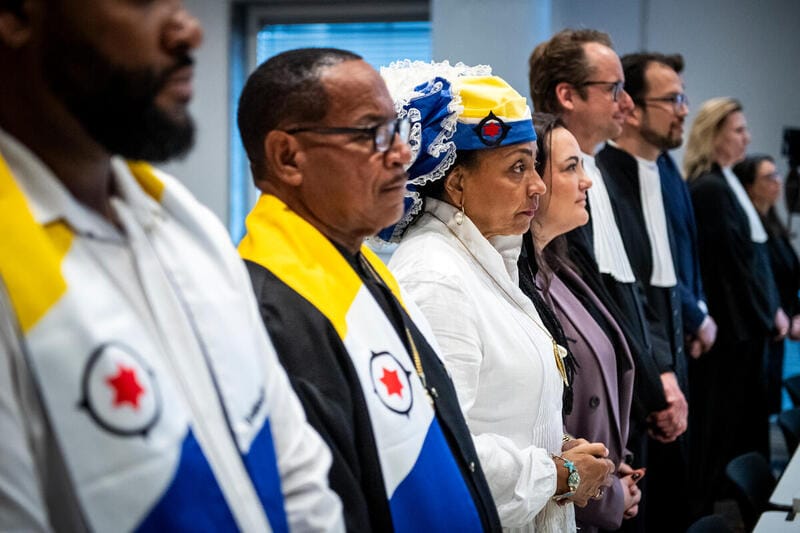
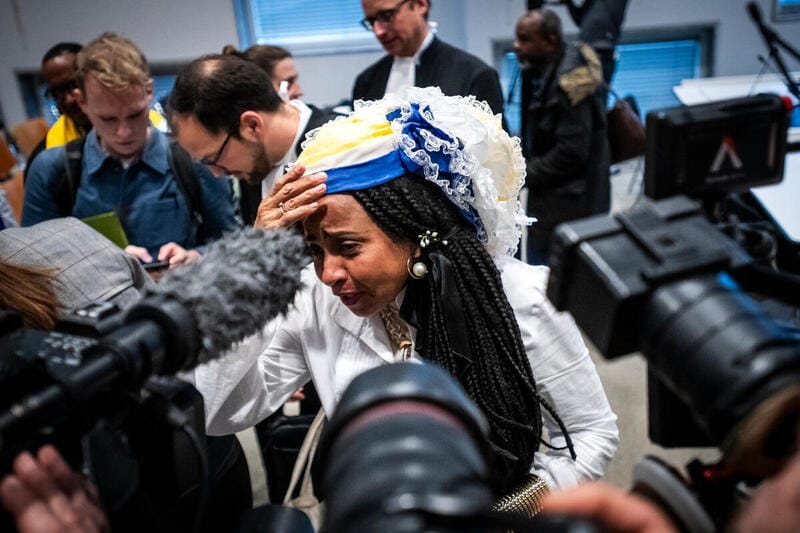
When I went to court for the ruling in late January my Dutch was not strong enough to understand the full statement being read out loud. So instead, I followed the claimants’ body language clues, watching Bernabala’s lacy headdress, in the blue, white and yellow colours of the Bonaire flag, bobbing gently as she nodded in apparent agreement with the judge. When she was moved to tears, Greenpeace’s team scrabbled to find her a tissue - was she crying in relief or despair?
It turned out that the court had little time for the state’s arguments, pointing out that it had not explained why measures were taken later and less systematically. “It is clear that circumstances on Bonaire differ from those in the European Netherlands and therefore require a unique approach; however, these circumstances point to a need for more mitigation and adaptation measures sooner,” said the judgment.
This was discrimination, the court ruled, a clear violation of the European Convention on Human Rights. The government must now produce a proper adaptation plan for Bonaire and do more to reduce its emissions.
In a few paragraphs, the artificial wall that the Netherlands had built between its mainland in Europe and an outlying territory more than 7,800 miles away came crashing down.

Outside the court, Bernabala was bursting with excitement. “I didn’t expect that it was SO good!” she told me. “Normally, the Dutch government looks above us. But now, because of the court, they have to listen to us, this little island. And that gives me satisfaction. Especially when they talk about discrimination - that hits me,” she said, striking her breast.
It was a landmark decision for communities with colonial legacies, which have not yet had much success with climate litigation. Last year, in a case brought by two Torres Strait islanders, an Australian court ruled that the federal government had no duty of care to its island nations to protect them from the impacts of climate change or to help them adapt (a decision that is being appealed).
However, courts have not yet gone so far as to find a state accountable for climate harm caused to someone outside its territory.
In its dismissal of a climate lawsuit by a group of young Portuguese people against 32 members of the Council of Europe, the European Court of Human Rights explicitly rejected this idea, although it didn’t rule out the possibility of ‘extraterritorial’ action in domestic courts.
Other courts have come to different conclusions; in a 2017 advisory opinion sought by Colombia about harm to the marine environment caused by development projects in the Wider Caribbean Region, the Inter-American Court of Human Rights (IACHR) said states do have to prevent environmental harm beyond their borders.
The Committee on the Rights of the Child, too, while dismissing a landmark claim by a group of young people that countries perpetuating the climate crisis were violating their human rights, set a groundbreaking development in international law that states are responsible for harming people outside their borders.
The three major advisory opinions on climate change from the International Tribunal on the Law of the Sea (ITLOS), IACHR and the International Court of Justice (ICJ) solidify this reasoning. The IACHR’s opinion, for example, states that “climate damage is, by its nature, transboundary” and says lawsuits seeking redress for it can absolutely be brought against by people and organisations outside its territory.
"Climate change carries no passport and knows no national borders"
“Climate change carries no passport and knows no national borders,” former UN general-secretary Ban Ki-Moon told states in 2015, urging them to act on their common interests. However, in the continued absence of satisfactory global action to tackle its root causes, experts expect more cross-border climate litigation - perhaps even one day a state suing another - and have imagined a variety of possible ways of making these arguments. There may even be a way of making a case that the US’ invasion of Venezuela earlier this year broke international law on climate change.
In future, courts may even have to tackle issues of sovereignty sparked by the impacts of climate change and the specific question of what happens to a country’s borders if and when sea levels rise. The ICJ, for its part, concluded that nations should maintain their statehood and maritime boundaries even if their land disappears underwater, echoing a recent report by the International Law Commission.
Climate litigation has also questioned the extent to which a country is responsible for emissions outside its territory, for example fossil fuels that are exported and burned elsewhere or products made in another country and imported (known as embedded emissions). Such calculations can enormously change national carbon footprints, with implications for both climate and trade law.
Courts ruling on climate lawsuits Netherlands, Germany and Belgium have tended to stick narrowly to territorial emissions. But in its ruling in the landmark KlimaSeniorinnen case, the European Court of Human Rights said Switzerland is responsible for its embedded emissions, which made up 70% of its greenhouse gases in 2015. What the state actually has to do about this is fuzzy, although experts suggest it could require import restrictions, sustainability supply chain legislation or carbon border adjustment rules. (I’ll be returning to the question of exported emissions in future newsletters).
The issue has already led to tension between countries. China has rejected the assertion by the ICJ that a country like itself with rapidly rising greenhouse gas emissions should have greater responsibility for cutting them, on the grounds that this growth is essentially the result of importing developed countries’ emissions.
Making the business case
Corporate climate litigation, meanwhile, is proving rather more amenable to cross-border arguments. In the UK, Germany and Switzerland people affected by climate-linked disasters in the Global South are pursuing lawsuits against some of the world’s most polluting companies.
In December, a group of typhoon survivors in the Philippines announced they were suing Shell in the UK, where it is headquartered. They were soon followed by 43 farmers from Pakistan's Sindh region whose livelihoods were devastated by flooding, taking aim at German energy firm RWE and cement producer Heidelberg.
The following month, a Swiss court admitted a climate lawsuit against Swiss cement manufacturer Holcim brought by four inhabitants of Indonesian island Pulau Pari.
Although these cases have yet to be heard on the merits, they are supported by a growing body of scientific evidence and legal judgments. The Pakistan case, for example, followed hot on the heels of a court ruling in Peruvian farmer Lliuya’s damages claim against RWE, which failed but did establish that such litigation was legally possible.
And they come at a time when European courts have proved increasingly open to hearing and deciding claims brought by victims of disasters abroad. In November, the High Court of England and Wales found mining giant BHP liable for the 2015 Mariana dam collapse in Brazil. Another hearing has been set for October to determine damages for more than 600,000 victims, although BHP is still trying to get the claim thrown out, warning that it would ‘open the floodgates’ for litigation.
It is perhaps ironic that Shell moved its headquarters from the Netherlands in 2021, not long after losing a previous lawsuit on climate there. In a world of multinational corporations and increasingly stringent regulations covering their complex supply chains, the net for corporate polluters of all stripes may be closing.
There may well be more cross-border Global South cases, depending on how you define climate litigation, which reveal particularly creative approaches to climate justice.
None of this is to deny the reality of restrictive - even brutal - border control. Litigators told The Wave that plaintiffs in some climate cases have faced problems getting visas, despite seeming to have a valid reason to travel.
But it is clear that climate litigation has undergone an intense internationalisation.
While campaigners network for ideas and advice, judges too have increasingly looked to other jurisdictions for guidance about how to rule.
Four years ago academics and litigators were already highlighting the growing phenomenon of cross-fertilisation between courts in climate lawsuits. And this has only continued, seeding cases with successful judgments and the most potent ideas plucked from other jurisdictions.
Tomas Heidar, ITLOS president, told a recent conference in Hamburg that the advisory opinions reveal an “unprecedented convergence of judicial activity”, although it was striking how little the discussions touched on the litigation and campaigning that forced these rulings to happen to all.
A similar phenomenon can be seen in the kinds of arguments being made in lawsuits interrogating whether people get refugee status once they’re forced to cross a border for climate-related reasons - litigation on which is also growing.
The Bonaire plaintiffs have gone home now, buoyed up by the success of their case and perhaps wary of a future appeal. But even the Dutch government could not deny how important this moment was, saying the court had issued a “ruling of significance for the residents of Bonaire and the European Netherlands”.
And in the cross-fertilising spirit of climate litigation, could Bonaire inspire future lawsuits from other European overseas territories, as well as more cases testing the legal limits of geographical and political borders? Only time will tell.