
‘More influential than Urgenda’: UK Finch ruling 20 months on

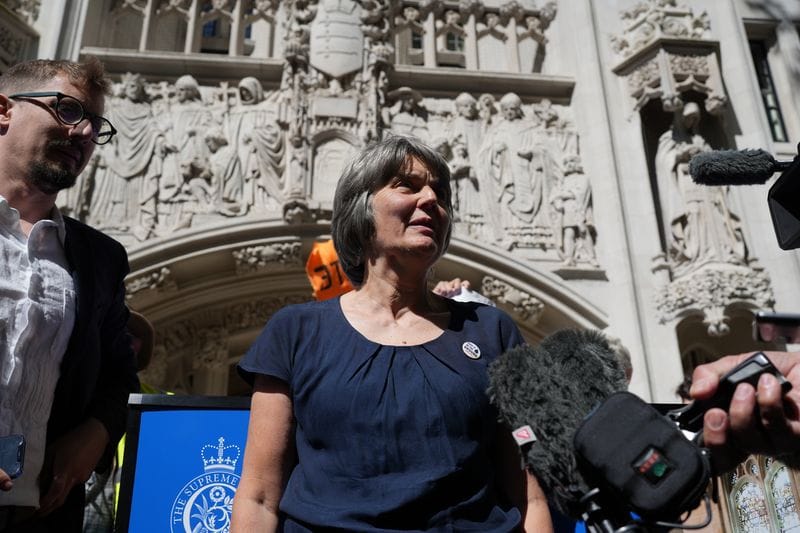
“I've become quite the celebrity in the small world of climate litigation,” laughs Sarah Finch, an environmental activist who won a landmark climate lawsuit that has made big waves in the UK and further afield.
Finch had challenged Surrey county council’s decision to extend planning permission for an oil drilling well at Horse Hill in Surrey.
Her case bounced up the judicial ladder and in June 2024, the Supreme Court found it “plain” that the climate impact of burning coal, oil and gas - one of a subset of downstream impacts that fall under the category of ‘scope 3’ emissions - must be taken into account when deciding whether to approve fossil fuel projects.
Although it took a while for oil to actually stop flowing from Horse Hill after the judgment, plans for new domestic fossil fuel projects soon began toppling like dominos.
In January 2025, UK government approval of the Rosebank and Jackdaw oil and gas fields in the North Sea was found to be illegal by the Scottish Court of Session because it did not account for greenhouse gas emissions caused by burning the extracted fossil fuels. The decision also led to the end of attempts to open a new coalmine in Cumbria - at least for now - and to drill for oil in Biscathorpe, Lincolnshire.
Beyond fossil fuels
In its judgment on the Finch case, the Supreme Court said fossil fuels were a special case and the same reasoning would not necessarily apply to other carbon-intense raw materials such as steel.
Nonetheless, it has had considerable impacts outside the fossil fuel sector.
The decision has been leveraged to reject planning permission for at least two industrial agriculture projects - an enormous pig and poultry farm straddling two sites in Norfolk and a 200,000 poultry unit near Shrewsbury.
Jake White, until recently head of legal advocacy at WWF UK, which worked with local communities to challenge the Norfolk farm plans, says his organisation used the judgment to help knock down arguments made by the developer, a company called Cranswick, that a climate analysis was not only unnecessary but not doable.
WWF demonstrated that such an analysis could be done using industry standard metrics. In fact, there is a strong link between the large quantities of soy the animals would be fed and the high-risk deforestation areas where that soy is produced (for example, in Latin America), says White. “The argument that Finch did require this assessment was the one the council backed.”
That information gave a much fuller picture of the project’s climate impacts - around 50,000 tonnes of CO2e each year - and in the end the council turned down planning permission for both sites on both climate and nature grounds.
“Truly Finch is the gift that keeps on giving!” says White. Finch, for her part, found those decisions “really gratifying”.
The case has had an impact on the UK’s high-emitting aviation sector too.
In an examination of Gatwick Airport’s attempt to build a second runway, the Planning Inspectorate said that the “landscape in respect of greenhouse gas emissions had changed” after Finch, so the emissions of planes landing at the airport had to be taken into account, as well as the emissions from outbound flights. “We have found, in the light of the Finch case, that the scale of greenhouse gas (GHG) emissions arising… would have a material effect on achieving carbon targets," it said, and recommended rejecting the project.
The government approved the project nonetheless, resulting in two separate judicial reviews with climate angles, which were recently heard at the High Court.
How successful this line of argument will be among judges is unclear. The same court recently dismissed a case challenging the expansion of Luton Airport, which had tried to use Finch to argue that the emissions of inbound flights should be included in its climate assessment.
Judgment takes flight
Finch was also referenced in a European Court of Human Rights case against Norway. Although the court dismissed the claim, it nonetheless set important standards for how states should undertake EIAs of fossil fuel projects.
It wasn’t much later that a Norwegian court declared licences for three oil fields in the North Sea illegal because they were approved without the full impacts of climate change being considered. “The dialogue between the UK and Norwegian courts on this issue was hugely instructive,” says White. While the Norwegian court does not explicitly cite Finch, it “seems to have relied on the more far-reaching UK decision to scrutinise harmful oil and gas projects there”, he says.
Gillian Lobo, a former government lawyer who went on to set up ClientEarth’s climate accountability team, says these developments show that the Finch case was in some ways “more influential than Urgenda”, the landmark climate lawsuit against the Dutch government that inspired many similar cases around the world.
Finch has not yet proved a complete death knell for polluting projects, though, because while it requires the broader climate impacts of all projects to be assessed, it does not force the hand of regulators to reject them.
After the judgment, the UK government published new guidance setting out how scope 3 emissions from oil and gas projects should be assessed in environmental impact assessments (EIAs), which it says "will ensure the full effects of fossil fuel extraction on the environment are recognised in consenting decisions".
Finch was impressed with the document. “All of the points we made in our submission on that guidance are there," she says. "It has to take account of the cumulative effect on a global basis, and they have to describe the effects on things like health and the environment. I feel like if the government, the regulators, go about it in an honest way, it's basically impossible to approve any new oil and gas production now because we know the carbon budget is pretty much bust.”
But it’s not the end of the story, because developers then submitted new climate assessments in line with the guidance. The assessment for Rosebank, from developers Equinor and Ithaca Energy, was out for consultation until November.
A decision on Rosebank is now imminent; the government has previously hinted that it may give approval.
Because of the litigation, we do at least know much more about the climate impacts of particular polluting projects. For example, the total emissions of Jackdaw, revealed in Shell’s assessment, could be up to 36 million tonnes of CO2 equivalent over its lifetime; Greenpeace UK says that’s equivalent to the average emissions of around 20 million cars driving on UK roads for a year.
If the UK government does approve Rosebank, further litigation is almost inevitable. Greenpeace has already threatened to bring a legal challenge over the government pre-empting its decision. Litigants are likely to refer to the International Court of Justice's recent advisory opinion, which says state actions to allow the production and consumption of fossil fuels, the granting of fossil fuel exploration licences or the provision of fossil fuel subsidies, “may constitute an international wrongful act".
Legal threats are not only coming from a climate perspective; the Scottish Palestine Solidarity Campaign has put the UK government on notice over a link between Rosebank and illegal Israeli settlements in the West Bank.
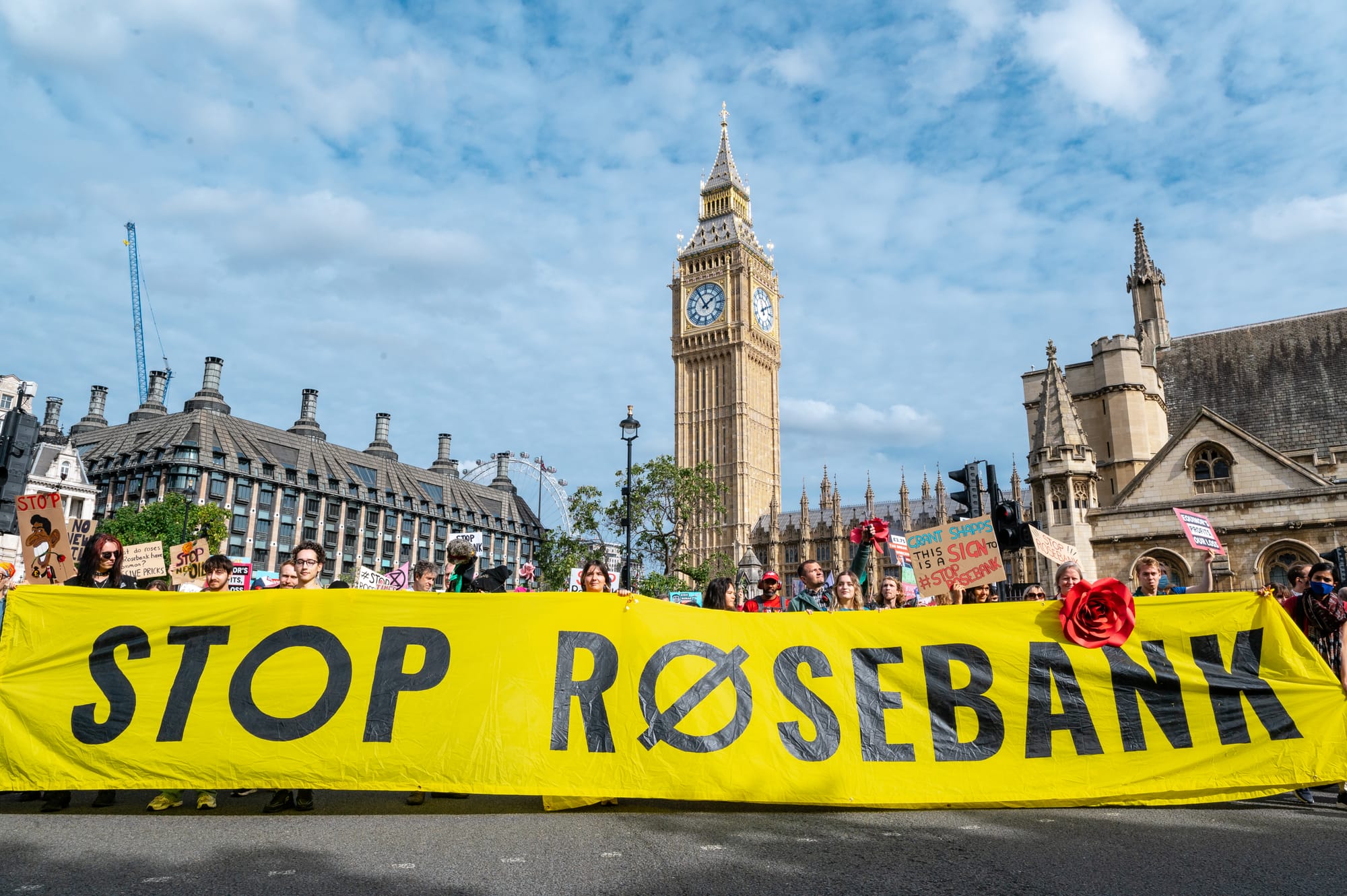
Activists outside the Houses of Parliament in London campaigning against the licensing of Rosebank (Photo: Fossil Free London)
While Rosebank is a high-profile development that needs approval from national regulators - and will get a lot of attention whichever way it goes - the Finch decision is still quietly being wielded at a local level.
Planners at Dorset Council, for example, delayed a decision on whether to approve an application by Egdon Resources to expand its oil operations at Waddock Cross, seeking more information about its climate impacts after interventions from local campaigners and Finch herself. The matter was then bumped up to national level.
Finch has some sympathy for these local regulators, which are mainly set up to examine local issues. “They know all about traffic generation and visual harm, but they don't know [how to do climate assessments], and they can't afford to pay for consultants to do it for them. So they have been put in a difficult position.
“But it's also very notable that a well-informed citizen who's taken an interest in it - like me for example - probably knows quite a lot more about it than a planning officer who's had a 30-year career and is really on top of his game in terms of local planning.”
The UK government, for its part, announced in November that it would not issue licences for any new onshore or offshore oil or gas fields, although it is not clear what will happen to legacy sites or existing ones that seek to expand.
On the flip side, the case has got caught up in a backlash to climate litigation in the UK, which has resulted in plans to reform judicial review.
And last year, a government-commissioned report into nuclear regulation recommended that the government “legislate to overturn the Finch judgment”. It argues that the decision widened the scope of EIA to such an extent that it must now consider any indirect effects of a project, and that this would compromise low-carbon development in general. Finch has rubbished this idea.
“Who knows how far its impacts will reach?”
What does the future bring? “I think we will continue to see the Finch judgment being applied in new and interesting ways across the environment space in the coming years,” says White. This could even affect how we assess nature impacts, he suggests. “Who knows how far its impacts will reach?”
The Weald Action Group, emboldened by the win, has gone onto to launch a new legal challenge on methane, hoping to secure another 'Finch' moment.
Finch herself feels massively privileged to have been involved in this case, although she is keen to stress that it was a group effort. “If I hadn't stepped forward, probably someone else would have. I’m very proud of what we did and the effect that it's had. On a personal level, it's kind of broadened my life.”
And although her name is now synonymous with a legal judgment, she recognises that it has a life of its own. “I'm just so glad I've got a name that's easy to spell and pronounce.”
But she still feels that Rosebank is the key test of its success. “If the government does give the go-ahead despite everything, then I think: ‘Okay, was that Supreme Court judgment really worth anything?'”