
The US invented climate litigation. It may end up going to its funeral

Put on the kettle and let me take you back a full 40 years to the US. At that time, the National Highway Traffic Safety Administration decided to water down the CAFE (corporate average fuel economy) standard, which regulates how far vehicles must travel on one gallon of fuel.
Peter Lehner had recently started working as a lawyer for the City of New York. Fresh out of law school, he helped build a pair of lawsuits together with peers in the City of Los Angeles challenging the CAFE change on the grounds that it would make local air pollution worse. Together, they argued that the traffic agency should have written an environmental impact statement (EIS), a detailed document that examines the potential impacts of a decision on the environment and outlines possible alternatives.
When environmental non-profit Natural Resource Defense Council (NRDC) joined the effort a little later, it brought in further concerns. It argued that the agency’s failure to produce an EIS would also make it too easy to “dismiss the potential ill-effects of the extra carbon dioxide emitted as a result of the CAFE rollback on global warming”. That twist turned the case into the world’s first piece of climate litigation.
The court ultimately found that the regulator had discretion not to produce an EIS and dismissed the claim. But Lehner, now managing attorney on sustainable food and farming for NGO Earthjustice, tells The Wave: “Nobody in that case at that time really disputed the reality of climate change. They understood that if you burn the stuff, you get emissions. And the emissions drive global warming.”
Something's brewing
Skip forward two decades and efforts to sow doubt about the science of climate change were bearing fruit; the federal government now agreed with fossil fuel companies that climate science was “too uncertain” to act on. “The industry disinformation campaign had paid off,” reflects Lehner.
It took a legal showdown between Massachusetts and the US Environmental Protection Agency (EPA) to get greenhouse gases listed as pollutants - the so-called ‘endangerment finding’ - providing a legal foundation for regulating them.
Another two decades have passed and the EPA has now repealed its endangerment finding. Once again, litigation is having to be invoked to challenge the decision. It’s a stark reminder of how deeply progress is underpinned by persistent civil society awareness and action, but also of how far backwards the US has gone.
The attacks are now coming from all sides: the Supreme Court is reviewing a key climate accountability lawsuit against two of North America's biggest fossil fuel firms, with potential impacts on many other cases; a legal shield from climate liability is likely to be passed in Utah in the coming days, setting a precedent for other states, alongside a possible federal liability waiver; and the federal government is challenging state superfund laws. All this while the Trump administration shows active disdain for the rule of law.
And while it seemed for a time that climate change was no longer up for debate in courts themselves, a document that judges have long used to help deal with scientific testimony, the Federal Judicial Center’s Reference Manual on Scientific Evidence, has become another pawn in the fight.
The fourth edition of the manual, produced jointly with the National Research Council, included a lengthy chapter on climate science. It explained how we know the climate is changing, how international consensus on the subject was built and the role of the Intergovernmental Panel on Climate Change, what impacts rising greenhouse gas emissions will have, and the role of expert witnesses in communicating and interpreting this evidence, alongside a glossary of key terms.
The chapter was written by two experts from Columbia University: Jessica Wentz, non-resident senior fellow at the Sabin Center for Climate Change Law and Radley Horton, professor at Columbia Climate School. It is detailed, cautious and extensively referenced, an “essential tool” for judges who aren’t always willing to engage with science.
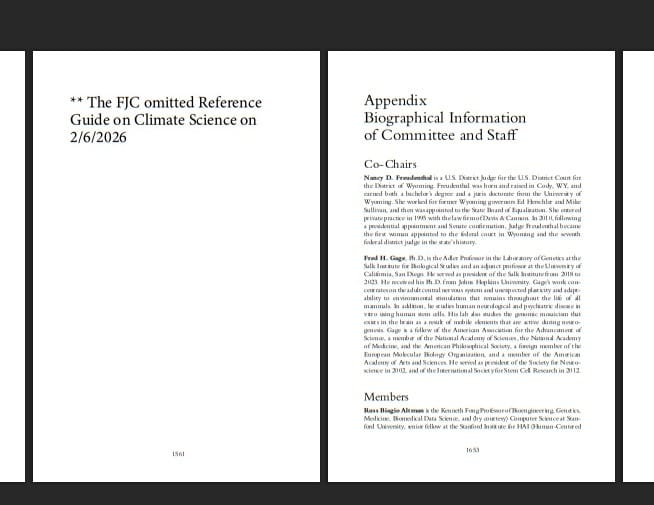
I linked to a copy of the document on the National Academies website because the chapter was removed by the Federal Judicial Center earlier this year following a written demand by 27 Republican attorneys general. And that didn’t come out of the blue; it followed lobbying of the Trump administration by energy non-profit Power the Future to investigate what it called a "national lawfare campaign" by climate activists aimed at influencing judges.
It hasn’t stopped there. A group of Republican attorneys general are now demanding that the federal government cuts all funding to the National Academies over the chapter, claiming it was “designed to influence judges in multi-billion-dollar climate cases".
The authors of the climate chapter, by the way, defend it vigorously. And it's worth noting that while the chapter itself was excised completely, it was done rather clumsily. The Federal Judicial Center didn't bother to change the page numbers (see screenshot above) or to remove various other references to climate science, from the introduction itself to an acknowledgment that public perception of climate change has been affected by "strategic manipulation from stakeholders who stand to be harmed if the public were to understand the true state of scientific consensus surrounding the hypothesis".
It's not the only recent attack on climate science. The Trump administration is planning to dismantle an important lab - and the universities behind it are now suing.
All of this is the intentional result of industry disinformation, writes Carly Phillips, a research scientist with the Science Hub for Climate Litigation at the Union of Concerned Scientists, and could succeed in obstructing access to reliable, scientific information.
Subpoena colada
I don’t want to leave you with an overwhelming sense of despair.
The US remains the country with by far the highest number of climate lawsuits, and campaigners have recently had some challenging climate funding rollbacks, offshore wind blocks and anti fossil fuel boycott laws. If the Supreme Court doesn't end up killing accountability litigation, its most advanced cases are champing at the bit for a trial.
It's also noteable that the EPA’s decision to scrap the endangerment finding did not rely on a Department of Energy report written by climate sceptics, which had been undertaken illegally. “I think they know that in an objective court.. the proclamations of all of the scientific bodies of the world have a weight that at this point is undeniable,” says Jason C Rylander, legal director of the Center For Biological Diversity’s Climate Law Institute.
Nonetheless, it's clear that the US is at a point of inflection, with climate litigation in the eye of the storm. Campaign groups tell me they are already shifting their litigation strategies, trying to raise the profile of particular issues to drive public discourse and inspire new laws rather than relying on increasingly conservative courts and outdated rules to win a case. In the meantime, the damage that has already been done will take years to mend, and we can only hope it doesn’t spiral outwards.
Maybe scratch that coffee; pour yourself a double whisk(e)y instead.